
Showing posts with label comics and animation. Show all posts
Showing posts with label comics and animation. Show all posts
Thursday, September 20, 2012
Linguistics and the Study of Comics
Because I've talked about comics and autism as well as comics and literacy here, I thought you might be interested in this review of Linguistics and the Study of Comics (edited by Frank Bramlett).


Wednesday, March 26, 2008
Too Cute
Collin found the most precious thing...

I'm sooo jealous he found it!
See more here.
In a box of recent donations, we found an old journal written by a kid named Evan. It’s a Star Wars : Episode I journal, and it contains three days in the life of a child, from October 6th, 2001 until the 8th. Every page has a short observation about something that occurred to him that day, and a small illustration of the thought. After that is a large section of missing pages, torn for the book for some mysterious reason, probably just as interesting as the remaining contents.

I'm sooo jealous he found it!
See more here.
Tuesday, March 25, 2008
My Latest Kick: Kitty Pants Which Are Too Tight
When my cat is acting cranky, which is quite often, I've been asking her if her kitty pants are on too tight; she meows in agreement. And now when the kids are cranky, I've been saying their kitty pants are on too tight.
The other day, while explaining what this meant to the kids (which was necessary because they only listen half the time, so they miss things), the eldest still looked perplexed.
I did the old, "Do you need to me to draw a picture for you?"; she took me up on it. Not to be bested, I turned to hubby and told him to draw it. He did.
And so I give you, Kitty Pants (Which, In All Likelihood, Are Too Tight):

Still not willing to let it go (or perhaps not willing to let my delight reign supreme), the younger insisted that hubby ought to have made a hole for the cat's tail. I said that with kitty pants, the tail is covered, like an extra leg, only without a hole at the end. "This," I said, "is why when kitty pants are too tight, cat's get cranky."
There were no more questions.
The other day, while explaining what this meant to the kids (which was necessary because they only listen half the time, so they miss things), the eldest still looked perplexed.
I did the old, "Do you need to me to draw a picture for you?"; she took me up on it. Not to be bested, I turned to hubby and told him to draw it. He did.
And so I give you, Kitty Pants (Which, In All Likelihood, Are Too Tight):

Still not willing to let it go (or perhaps not willing to let my delight reign supreme), the younger insisted that hubby ought to have made a hole for the cat's tail. I said that with kitty pants, the tail is covered, like an extra leg, only without a hole at the end. "This," I said, "is why when kitty pants are too tight, cat's get cranky."
There were no more questions.
Sunday, February 03, 2008
Potty Training Parents Get It
Unmentionables, The Comic:

Being a three year old’s first pair of underwear is a dirty job, but somebody’s got to do it.
After seeing what happed to the diapers, Tinkle hopes it’ll be somebody else.

As a pair of kid's superhero underwear designed to look like the famous cod piece worn by “Tremendous Man”, Tinkle had hoped to live a more heroic, cleaner life style. But unfortunately he's destined to follow in the skid marks of his working class father Jim Shorts, a sweat stained pair of tightie whities , or worse, his grandmother, a loving, but rancid pair of weathered, granny panties.The other characters are a riot too, so check it out.
Tinkle spends his first few days on the job, desperately trying to avoid his underwear duties, or any doodies for that matter. But when his disgusting, yet beloved, grandmother is hauled off to the thrift store, Tinkle sets off with the hope he can save her, the hope he can become a real hero, and the hope that things don’t get messy.
Tuesday, January 08, 2008
More On Comics & Reading, From The Experts
In addressing the matter of light reading became a stepping stone to further reading, this piece by Bernice E. Cullinan (New York University) published at the American Library Association has this to say:
Additional Reading:
In The New York Times, Superman Finds New Fans Among Reading Instructors.
Teaching Tips: Comic Strips as a Text Structure for Learning to Read, at the International Reading Association.
There is some evidence from case studies and large group research that light reading, such as comic books, leads preteens and young adults to more, if not always higher quality, reading. For example, researchers Dorrell and Carroll (1981) placed comic books in a junior high school library but did not allow them to circulate; students had to come to the library to read them. The researchers compared circulation figures of non-comic-book material and total library use during the seventy-four days the comics were in the library with the fifty-seve days prior. Library use increased 82 percent with a 30 percent increase in the circulation of non-comic-book material. Other studies, however, showed that comic book reading does not correlate positively with higher levels of literacy (Allen, Cipielewski, and Stanovich 1992).
Additional Reading:
In The New York Times, Superman Finds New Fans Among Reading Instructors.
Teaching Tips: Comic Strips as a Text Structure for Learning to Read, at the International Reading Association.
Bilingual Students Learn To Read By Sharing Comic books
More on literacy and comics, this from a press release from the International Reading Association:
Spider-man, Hulk, and Wild Girl Help First Graders with Language and Reading
Primary school teachers routinely read to their students, but it took an innovative first-grade teacher to interest Portland State University professor Jason Ranker in studying how comic books helped young English-language learners with reading and writing.
Ranker, whose research interests include visual literacy and marginalized learners, joined sixteen bilingual students one to two mornings each week to observe how their teacher developed sophisticated literacy skills by reading comic books to her class.
“Several researchers have noted the use of simplistic or reductionistic pedagogy when teaching reading to English-language learners,” Ranker suggested. “This teacher didn’t settle for that approach. Instead, she demonstrated that comic books can help students understand story structure, distinguish between dialogue and narration, and explore broader media issues—in this case, gender stereotypes.”To demonstrate, Ranker highlights three lessons. The teacher used a Spider-Man story to illustrate how problem-solution scenarios make a story interesting, a technique students put to use in generating their own stories, some about super-heroes, some not. It was the tale that featured both the Hulk and Catwoman that opened the issue of gender. A student’s question, “Who is stronger, Catwoman or Hulk?” led to an extensive discussion about how strength is portrayed and a search for a female superhero, Wild Girl, whose version of strength differed from the Hulk’s.
Ranker sees an important connection that students can make using their pop culture knowledge as a frame of reference for in-school literacy activities. “Movies, music, comic books, and video games tell stories in their own ways. They create familiar territory for students to learn about how stories are told. As the teacher guides them through the story, students also get insights into their own reading and writing practices.”
Ranker also addresses several other issues connected to the use of comics, but clearly sees a value beyond their use to motivate reluctant readers. “Because they have the capacity to increase interest and motivation, comic books are an effective way of increasing reading comprehension and comprehension strategies."As highly visual texts, they are especially effective for second language learners, who can use visual support even when they may not have the aspect of the relevant target language that they might need in the given instructional context."


Monday, November 26, 2007
Wiki huh-yeah, What is it good for?
According to Adam Tornes at Compete's Blog anime outranks sex in Wiki searches.

Please note that the largest percentage, 28%, is for "General Research" which according to the author of the post is for news, current events and cultural phenomena. However, after that, the greatest interests deemed not news or current events are "sex" and "anime" (at least in April of 2007).
This is what Tornes has to say about these searches:
Ditto for parents who think they'll learn about anime there -- once again, if there are references &/or warnings about hentai, I've not seen them; how many parents are also missing them?
Leading me to ask, a la Edwin Starr's song, War:
Wiki huh-yeah
What is it good for?
Absolutely nothing
Say it again y'all

Please note that the largest percentage, 28%, is for "General Research" which according to the author of the post is for news, current events and cultural phenomena. However, after that, the greatest interests deemed not news or current events are "sex" and "anime" (at least in April of 2007).
This is what Tornes has to say about these searches:
Anime (26%)Since Wiki is not exactly scholarly, I sure hope folks aren't "learning about sex and how to have it by referencing" it.
There is a tremendous amount of interest in learning about Pokemon and Naruto. Perhaps these are parents who want to know what their kids are going crazy over. My Mom didn’t know what “He-Man” was until I was a grown man reflecting on how silly Castle Grayskull was. My mom could have used Wikipedia in the 80’s.
Sex (16%)
What’s interesting about the top sex related terms on Wikipedia is that they do not appear to have gratuitous intent. The top terms include very straightforward inquiries on human reproductive ‘parts’ and basic concepts of what sex is and how it is performed. It appears many people are learning about what sex is and how to have it by referencing Wikipedia.
Ditto for parents who think they'll learn about anime there -- once again, if there are references &/or warnings about hentai, I've not seen them; how many parents are also missing them?
Leading me to ask, a la Edwin Starr's song, War:
Wiki huh-yeah
What is it good for?
Absolutely nothing
Say it again y'all
Thursday, November 08, 2007
More On Comics & Aspergers
Following my post on Auspies and Manga, and how I might learn something from my daughter's obsession with it, I spotted this post at Newsarama's blog. He's quoted a passage from Frank Santoro's post, which frankly is really for die-hard comic fans. But the passage pulled at my earlier thoughts & so I'm going to re-post it here for parents.
There’s often too much emphasis on reading a comic like a novel when really it should be discussed like a painting or a sculpture. Far from dismissing these “out there” comics… I found myself simply hoping to discuss them and appreciate them better, and to do that I think a broader approach has to be encouraged, towards a less conservative definition of comics… I’ve always felt that all comics are inherently narrative because of the form that the book takes. For that matter a single image, an abstract painting, for example, is often narrative. Jackson Pollock’s paintings are narrative — you can follow him, the story of him working by the lassos of color — and the same is true even with the color field abstractionists like Frankenthaler. It’s just a broader range, a greater bandwidth for inventing narrative.Again, I'm not really certain what this all means -- or if in fact it means anything in the world of Aspergers. But it pulls at the threads of the sweater just a bit more...
The Aspergers/Anime Connection
Allie, the eldest who's an Auspie, had oral surgery recently, so I went in search of cheap manga comic books. She loves anime and manga, but me not-so-much. I'm not only a fan of reading, but manga and anime present parenting problems. For example, in Japan animation and comics aren't just for kids but in fact has an adults only genre called hentai, which is porn. Even the graded or rated stuff isn't a certainty for I've found in books rated 13+ lots of nude topless women, in showers etc., with very adult themes, such as men spying on them. So you really have to screen books and videos to make sure they are appropriate.
 In the recent issue of Wired, there were several featured articles on manga, and while I was disappointed to not see any notices or warnings on the issue of hentai, there were some very interesting things. For example, How Manga Conquered the U.S., a Graphic Guide to Japan's Coolest Export is not only very cool but it gives newbies (manga virgins) an idea of what it's all about.
However, of most note to parents of special needs kids was this bit from This Is Your Brain On Manga:
While I originally barely tolerated anime, I did learn to twist that obsession of hers into the manga books -- hey, it was some form of reading. (And it did reignite her passion for reading after a several year hiatus.) But now I wonder if this "manga mind" thing, where a person views and interprets differently, is some key to further understanding how my daughter receives information.
Perhaps it will lead to more insight. Perhaps not.
But it does mean I will be moving more quickly on screening the piles of manga books and anime videos I have laying about the house.
 In the recent issue of Wired, there were several featured articles on manga, and while I was disappointed to not see any notices or warnings on the issue of hentai, there were some very interesting things. For example, How Manga Conquered the U.S., a Graphic Guide to Japan's Coolest Export is not only very cool but it gives newbies (manga virgins) an idea of what it's all about.
However, of most note to parents of special needs kids was this bit from This Is Your Brain On Manga:
and played But as a Westerner without deep experience with manga, I displayed the hallmarks of what we might call a "prose mind." My eyes herked and jerked across each page, stopping to linger over any text I encountered — almost as if I were scouting for words rather than absorbing pictures. a Then he asked one of his research assistants, 29-year-old NakamichiKeito, to step up. Keito was asked to read a passage from Yanki-kunMegane-chan, a series he doesn't usually follow. When NakazawaKeito's video, it was a revelation. His eyes slalomed smoothly from page edge to page edge, rarely stopping at the text. In fact, there were portions of pages that his eyes never touched — because, as Nakazawa explained, Keito was either processing the words through his peripheral vision or simply imputing what was there. Like a seasoned skier, he moved with great speed yet remained acutely aware of his surroundings.As a parent of an Auspie, I'm now thinking about manga differently.
Keito has a "manga mind," capable of understanding context, supplying missing information, and interpreting word and image as one.
While I originally barely tolerated anime, I did learn to twist that obsession of hers into the manga books -- hey, it was some form of reading. (And it did reignite her passion for reading after a several year hiatus.) But now I wonder if this "manga mind" thing, where a person views and interprets differently, is some key to further understanding how my daughter receives information.
Perhaps it will lead to more insight. Perhaps not.
But it does mean I will be moving more quickly on screening the piles of manga books and anime videos I have laying about the house.
Tuesday, October 30, 2007
I'm A Good Mom, Charlie Brown
It's The Great Pumpkin, Charlie Brown is on TV and Des is watching it.
I never liked Peanuts. I know it's anti-American to say so; Charles Schultz is like the Norman Rockwell for my generation. But I've always found it incredibly sad. Lucy taking the ball away, that snotty girl telling Charlie Brown he'll never ever be elected student body president, Schroeder having to put up with Lucy's obnoxious hanging around -- all sad. The comic in the paper wasn't much better than the specials either.
The only redeeming thing was Snoopy. But even his brother Spike was sad and lonely... always in search of a home.
But not letting the kids like &/or watch Peanuts is probably tantamount to child abuse, or at least neglect. So it's on the TV. And I just try to pretend I don't want to go cry somewhere.
I never liked Peanuts. I know it's anti-American to say so; Charles Schultz is like the Norman Rockwell for my generation. But I've always found it incredibly sad. Lucy taking the ball away, that snotty girl telling Charlie Brown he'll never ever be elected student body president, Schroeder having to put up with Lucy's obnoxious hanging around -- all sad. The comic in the paper wasn't much better than the specials either.
The only redeeming thing was Snoopy. But even his brother Spike was sad and lonely... always in search of a home.
But not letting the kids like &/or watch Peanuts is probably tantamount to child abuse, or at least neglect. So it's on the TV. And I just try to pretend I don't want to go cry somewhere.
Tuesday, January 31, 2006
Coloring For Grownups
Spending time with all three children can be difficult. We've got the age differences (5, 9 & 16), the abilitiy differences to pay attention (with the oldest), and then of course, the boy wants cars while the girls have limited interest in them (and he has a low tolerance for Bratz dolls and 'girl things'), so what do we do? Lots of crafts, and coloring.
To make it more interesting for myself, I like to title my 'art'.
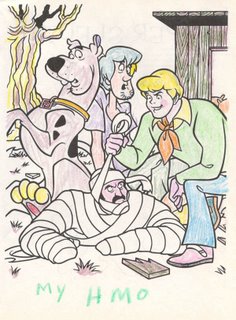
The first captures my thoughts on medical care in this country, and is titled "My HMO"
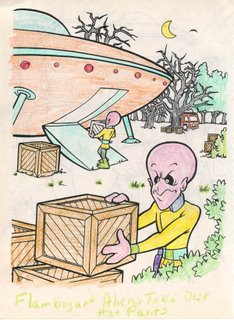
The second, named for the way I colored it & hubby's reactions to it, is called "Flamboyant Aliens Take Our Hot Pants:
With this new trick, I know I'll enjoy coloring more *wink*
To make it more interesting for myself, I like to title my 'art'.
The first captures my thoughts on medical care in this country, and is titled "My HMO"

The second, named for the way I colored it & hubby's reactions to it, is called "Flamboyant Aliens Take Our Hot Pants:

With this new trick, I know I'll enjoy coloring more *wink*
Subscribe to:
Posts (Atom)